



Today we’d like to introduce you to Adelita Candelaria.
Hi Adelita, we’d love for you to start by introducing yourself.
The summer between seventh and eighth grade, my mother looked at me and said, “Wow, you went from an ugly duckling to a swan in one summer.”
I’m sure she meant it lovingly. But when you’re thirteen, you also hear the other half of that sentence: apparently I had been the ugly duckling.
I had spent much of my early adolescence trying not to be noticed. I was insecure about my body and wore oversized clothes because hiding felt easier than being seen. Meanwhile, some of my friends seemed to be entering this new world of femininity much more naturally — fitted clothes, boys noticing them, first boyfriends. I was often the friend to the boy, not the girl he wanted to date. At thirteen, those things can feel like definitive information about who you are.
That summer, my older sister was getting rid of clothes. She had always been very petite, and I started trying on some of her dresses and more fitted pieces. I wanted to know what it might feel like to stop hiding and see myself differently.
I don’t think that summer suddenly made me confident. But it made me curious about presentation — how much could change simply by changing the way you chose to show up.
Around the same time, my parents were giving me a completely informal education in art, music and film.
I grew up on MTV and all the color and theatricality that came with it, but we also watched movies from decades before I was born. I became obsessed with faces: Louise Brooks and Clara Bow in the 1920s; Elizabeth Taylor, Marilyn Monroe and Brigitte Bardot; Twiggy and Peggy Moffitt; Debbie Harry; David Bowie.
It’s hard for me to separate the makeup from the music, clothing, photography and films because I was taking all of it in together. What fascinated me wasn’t simply that these people were beautiful. It was what an image could say. A Bardot eye told a different story from a Twiggy lash. Debbie Harry could look glamorous and a little dangerous at the same time. Bowie could make a face seem almost otherworldly.
I began to understand that a face could communicate something before a person ever spoke — that an image could create a feeling before you knew anything about the person in it.
That made me want to experiment. I became fascinated by transformation — how a few choices could make a face belong to another era, character or mood. I would sit in the bathroom and try to recreate a 1920s face, a Cleopatra eye, a dramatic ’60s lash or some kind of Bowie-inspired face painting. I wasn’t studying technique or thinking about becoming a makeup artist. I was experimenting — trying on an idea, becoming someone else for a minute, and then washing it all off.
Eventually my friends started asking me to do their makeup for formals, dances and special occasions. There were dances I never attended because I was happier getting everyone else ready and then going home to watch movies with my parents.
At art school in San Francisco, makeup simply became another medium. I experimented with psychedelic ’60s looks, body painting, and horror and special-effects makeup for friends’ film projects. There still wasn’t a grand career plan. I was following whatever interested me.
A couple of hairstylists I met in my early twenties were the first people who pushed me to take it seriously. One was a salon owner I assisted who brought me on set. Another gave me considerably less romantic advice when I told her I had no money to build a professional kit:
“Fake it until you make it. Get a job at Nordstrom. Use the discount. Start building your kit. Meet people and figure it out.”
So I did.
That eventually led me to MAC Cosmetics in Portland, and I don’t think I understood at the time how profoundly that experience would shape me. For me — and for so many artists I knew who came up through the company — MAC was much more than a place to learn makeup. It gave me an education that extended far beyond products or technique.
I learned how to work with all kinds of people, how to listen, collaborate, hold myself to a higher standard, and keep developing even when I thought I was already good at something. It taught me that growing didn’t mean you weren’t good enough. Growing was the point.
MAC prepared me for nearly every job I’ve had since. It made me a stronger artist, but it also shaped how I approach business, service and people. I learned to really look at the person sitting in front of me and understand that they may see their own face very differently than I do. Doing makeup well has as much to do with understanding the person as it does the products.
My life moved through San Francisco, Portland, Denver and eventually the Central Coast. People sitting in my chair sometimes ask which place was my favorite, and I can never really answer.
How do you choose between different versions of your own life?
Each place gave me something different. I met people who changed me, made mistakes, started over, and kept discovering new ideas about who I was and who I might become.
Looking back, I think that’s probably the thread connecting all of it. I’ve always been interested in identity — how we express it, how it changes, and how much of ourselves can be communicated through seemingly small choices.
That’s where Beauty Goes Everywhere comes from.
Alright, so let’s dig a little deeper into the story – has it been an easy path overall and if not, what were the challenges you’ve had to overcome?
The challenges have been less about starting the business and more about continuing to grow within it.
Makeup is technical, subjective and constantly evolving. Techniques change, products change, trends come and go. There’s a balance in creative work: you need enough confidence to develop a point of view, but enough humility to keep questioning your own work.
A lot of my growth has come from teaching myself, staying curious, and being willing to look at something I’ve done and say, I can do that better.
Then there are the practical realities — the cost of running a business, continually investing in products and education, and learning how to make creative work sustainable.
Confidence is probably the challenge that never completely disappears. Social media can magnify that enormously. There are days when I feel really proud of what I’m creating, and others when I see someone else’s work and think, Why am I doing this? Everyone is better than me. You have to learn not to let yourself spiral there.
I definitely don’t have everything figured out, and I’m okay with that. I don’t think I ever want to reach a point where I feel finished. Part of what I love about being an artist — and a human — is knowing there will always be something I can understand better or do better.
Thanks – so what else should our readers know about your work and what you’re currently focused on?
Makeup is only half the job. The other half is understanding people.
Over the years, I’ve come to believe that emotional intelligence is every bit as important to this work as technical ability. Makeup is an intimate service. You’re physically very close to someone, and with weddings especially, you’re often meeting them on a day carrying a lot of emotion, expectation and moving parts.
You have to be able to read the person and the room. Sometimes that means conversation; sometimes it means quiet. Sometimes someone knows exactly what they want, and sometimes you have to listen closely enough to understand what they mean when they say, “I want to look like myself,” or “I’m afraid of looking too made up.” There can be a lot underneath those sentences.
That care starts long before someone is sitting in my chair. The communication beforehand, asking the right questions, understanding the broader vision and noticing the things someone may not know to think about yet are all part of the work for me.
After nearly twenty years, experience isn’t just knowing which product to reach for. It’s having enough perspective to anticipate, adapt and create trust so that when the day arrives, someone can hand that part over to me and know I’m paying attention.
I’ve also learned that running a creative business means the artistry and professionalism can’t really be separated. The work matters, but so does how someone is communicated with, prepared for and cared for throughout the experience.
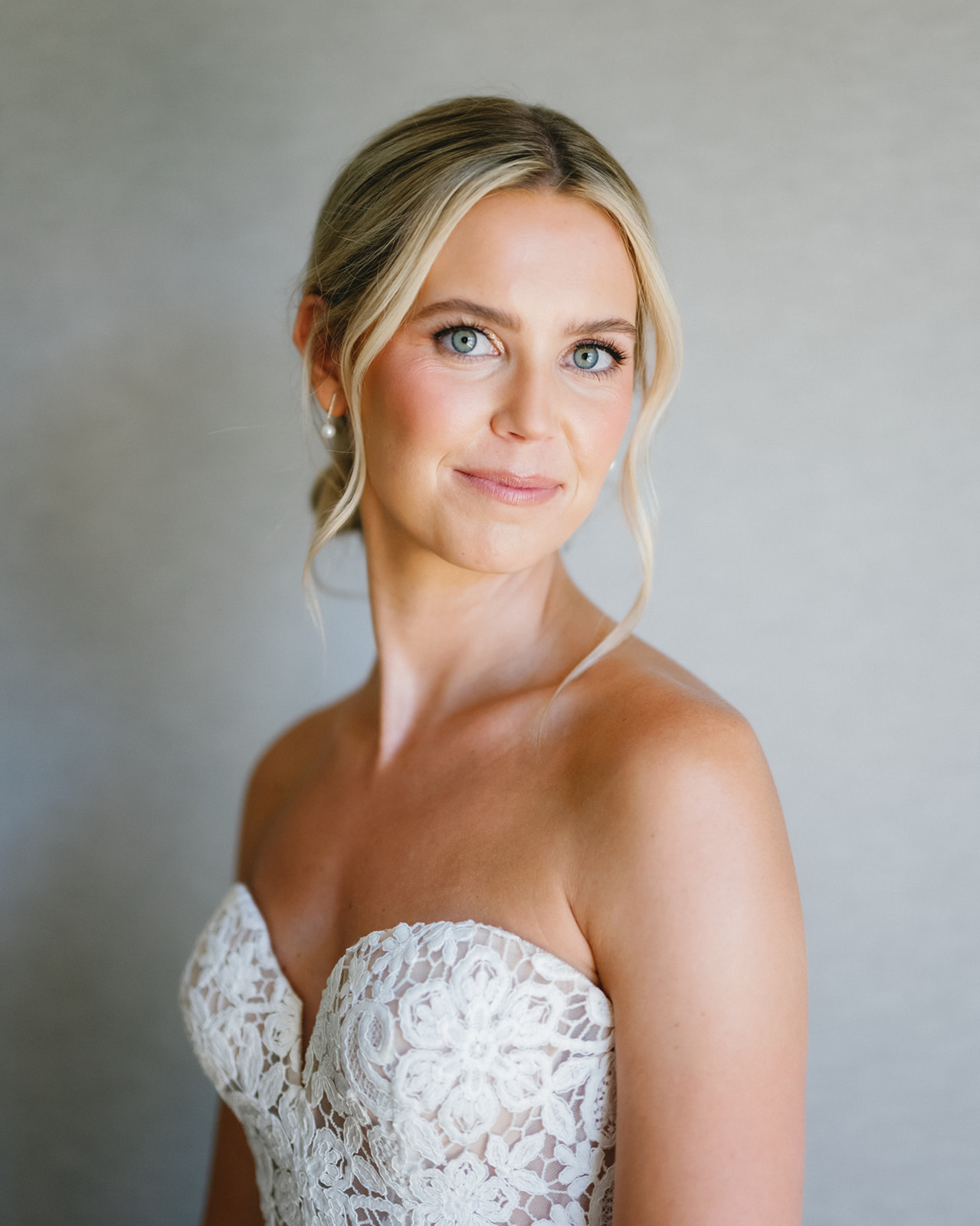
These days, most of my makeup work is bridal, largely throughout San Luis Obispo County and the Central Coast. I love working across different ages, skin tones, features and personal styles — from someone who wants barely-there makeup to someone who feels most like herself in full glamour.
Alongside Beauty Goes Everywhere, I also work as a Patient Care Coordinator at Chalekson Plastic Surgery + MedSpa, and that has given me another perspective on many of the same ideas.
People ask me pretty often why I work two jobs. There are practical reasons, of course — work supports a life — but I’ve realized it’s also part of how I’m wired. I’m very curious, and I like having different places to learn, contribute and develop different parts of myself. Even if I could make the same income doing only one thing, I genuinely don’t think I would choose to.
The two worlds inform each other. What I learn about people, service, aesthetics and communication in one changes how I approach the other. I also like continuing to build different skills, knowing I can adapt and pivot, and not relying too heavily on one version of myself.
Maybe I do have a bit of a workaholic streak. But I’ve also started to understand how much I value being useful. Both of my jobs put me in situations where people are trusting me, relying on me or asking me to make something easier for them. Feeling that what I do matters to someone is incredibly rewarding.
I’m aware there’s probably a point where being needed can become too important, and I’m still figuring out what the healthiest version of that looks like. But I genuinely love working, learning and feeling like I’m progressing.
Aesthetic medicine is much broader and more nuanced than the stereotype people sometimes have of it. People of different ages, genders and backgrounds consider cosmetic treatments and surgery for reasons that are incredibly personal, and much of the work is subtler than people realize.
Sometimes the goal isn’t to look dramatically different at all. It’s to refine something that has bothered someone, restore something that has changed, or help the outside feel a little more aligned with how that person sees themselves.
That fascinates me because it brings me back to something I think about constantly in makeup: the difference between an idea of beauty and the experience of feeling beautiful.
There are features our culture has celebrated at different times — full lips, high cheekbones, certain eye colors, a particular brow. We’re surrounded by ideas about what beauty is supposed to look like.
But I’ve never really thought beauty worked that way. I’m more interested in individuality, including the characteristics someone else might call imperfect. Those are often the things that make a face interesting in the first place.
My aesthetic tends to live somewhere between polished and undone — beautiful skin, thoughtful definition and makeup that photographs well without overtaking the person wearing it. I don’t want everyone who sits in my chair to leave with the same face. I want to understand what someone is drawn to, what they want to emphasize, how they see themselves and how they want to feel when they look in the mirror.
That doesn’t always mean “natural” makeup. I love glamour, drama and a strong point of view when it makes sense for the person. What matters to me is that it feels intentional and that it belongs to them.
I think there’s an alignment involved in doing this work well. Your mind has to understand what you’re doing. Your heart has to understand the person and why you’re doing it. And then your hands have to make it real.
When those things come together, you can create something beautiful without needing to erase what was there to begin with.
That idea sits at the heart of Beauty Goes Everywhere. I don’t think beauty belongs to one age, one face, one body, one gender or one aesthetic. And I don’t think it exists only in people.
Beauty can be a person, but it can also be a place, a piece of music, an experience, or a moment when everything around you seems to come together — the person you’re with, the environment you’re in, what you’re hearing, what you’re seeing and how all of it makes you feel. There are moments when you look around and think, God, all of this is beautiful.
That’s really what Beauty Goes Everywhere means to me. Beauty isn’t confined to one thing or one place. Sometimes you create part of it, and sometimes you’re simply paying enough attention to realize it was already there.
Some of the moments I’m proudest of in my work are much quieter. Sometimes someone looks in the mirror and doesn’t say anything at first — which, as a makeup artist, can be terrifying for a few seconds.
But sometimes that silence is someone seeing something in themselves they hadn’t quite seen before. Not because I’ve turned them into somebody else, but because they’re seeing what was already there a little differently.
I think that’s incredibly special.
What makes you happy?
What makes me happiest is recognizing a really good moment while I’m still in it.
I don’t mean that everything in life has to be perfect. Sometimes a handful of things you love just seem to line up at exactly the same time, and somehow you catch yourself noticing it while it’s happening.
That can be at the end of the night when my husband and I are getting ready for bed, our dog is settling in with us, and I think, This is really good right now.
My husband is a huge part of that sense of home for me. He’s been incredibly supportive of the work itself and the amount of myself I tend to pour into it, and having a real partner beside me has made more of this possible than I probably say out loud.
It can be after a hike or a good workout, when I’ve gotten cleaned up and feel accomplished, and then I’m sitting down with friends and that first sip of wine and first bite of something delicious hits. There’s this little internal, Damn. Today is a really good day.
Sometimes, if a day is going particularly well, there’s even a tiny part of me that thinks, I really hope nothing goes wrong now. Like maybe I shouldn’t acknowledge it too loudly or I’ll somehow tempt fate. I know that’s ridiculous, but I do think it. Maybe that’s part of why I notice those moments so much. You know they aren’t guaranteed.
It happens through my work too. There’s something incredibly special about a bride looking at herself on her wedding day and knowing that, out of all the people she could have chosen, she trusted me to be there for that moment. I never want that to become ordinary to me.
But happiness can be incredibly ordinary too, and I mean that in the best possible way. Having the house to myself, getting everything off my to-do list, putting on a favorite song and becoming completely absorbed in it. Laughing with someone I love. Feeling comfortable in my own home and my own life.
Music does that for me a lot. A song can hold so many versions of your life at once. You hear it now, but you’re also remembering where you were when you loved it ten or twenty years ago, the people you knew, the places you were, even people you’ve loved who may no longer be here.
Not every important memory needs a photograph. Some of them just live inside us.
I’ve also become less interested in happiness as some permanent state you’re supposed to achieve. Life is complicated. There will always be things outside of our control, things we worry about, things we wish were different.
Sometimes happiness is simply being able to put your head down at night and feel at peace with the way you moved through the day — knowing that you genuinely tried to be a good person, that you did the best you could with what was in front of you, and that you can get up tomorrow and try again.
There’s something beautiful to me about an ordinary life that feels good to the person living it.
Maybe that’s part of what Beauty Goes Everywhere has come to mean to me too. Sometimes it’s a face or a piece of art. Sometimes it’s music, a place, the person beside you, or a moment when all of those things seem to line up at once.
Not everything is beautiful all the time. It isn’t. But beauty can show up almost anywhere when you’re present enough to notice it.
Maybe happiness is when your thoughts, your heart, and the life you’re actually living feel aligned.
And you catch yourself thinking, This is really good. I want to remember this.
Contact Info:
- Website: https://Www.Beautygoeseverywhere.com
- Instagram: https://www.instagram.com/beautygoeseverywhere/