




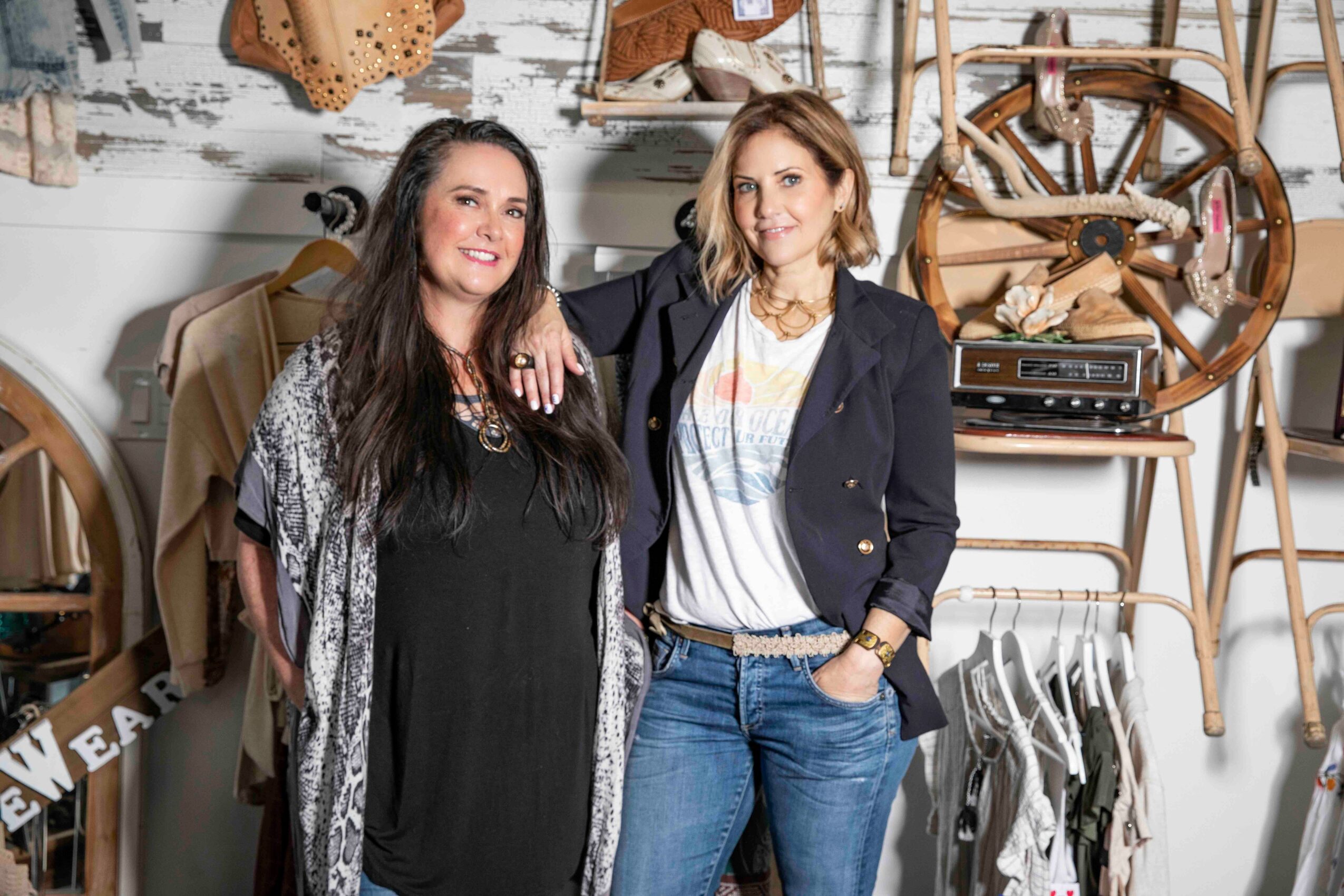
Today we’d like to introduce you to Kimberly Lau And Linda Young.
Hi Kimberly Lau and, can you start by introducing yourself? We’d love to learn more about how you got to where you are today?
Project ReWear really started with two moms, a lot of clothing, and a question we couldn’t stop thinking about: Where does all this go?
We’re Kimberly Lau and Linda Young, and we came to this from very different professional backgrounds. Kim spent years in wealth management, where she developed a strong foundation in strategy, operations, and financial planning. Linda spent more than 20 years in retail management and global brand development, followed by years working in the nonprofit thrift space. Between Linda’s firsthand experience seeing how much clothing moves through traditional donation systems and our own experiences as moms and consumers, we became increasingly aware of just how much perfectly usable clothing exists – and how little visibility most of us have into what happens to it once we’re finished with it.
We knew we didn’t want to simply open another thrift store. We wanted to see whether we could build a better local system for keeping clothing in use for as long as possible.
Project ReWear officially opened its Thousand Oaks store in December 2024. It’s a small space – about 1,200 square feet – but from the beginning, the idea behind it was much bigger than the retail footprint. We wanted secondhand shopping to feel accessible, affordable, and easy enough that it could become second nature. Our clothing is priced from $2 to $18 because we believe sustainability shouldn’t be something only certain people can afford.
Very quickly, we also realized that selling secondhand clothing was only one piece of the puzzle. Not every item has the same best next life, so Project ReWear began evolving into a circular system with multiple pathways. Today, that includes our everyday retail store, VIP 1st Dibs events, high-volume WEARhouse sales, a free Community Rack and redistribution to community organizations. For clothing that is no longer wearable, we’re actively working to develop responsible upcycling and downcycling solutions rather than treating the trash can as the default answer.
Measurement became another huge part of our journey. Through The Landfill Project, every purchase is weighed so we can track how many pounds of clothing our community is putting back into use. To date, that’s 17,526 pounds kept in circulation through purchases. We also launched The Don8 Project in July, which weighs donations coming into our ecosystem and allows donors to follow their own impact through our private Don8 app, accessed via QR code. Our community has already donated 14,976 pounds through that side of the system.
What has probably surprised us most is how much the community has shaped what Project ReWear has become. We kept seeing new needs and asking, how can we create a pathway for that? Our WEARhouse sales showed us how dramatically affordability can increase the amount of clothing that gets reused. Our Community Rack gives people experiencing financial hardship access to clothing for free. And through community redistribution, more than 2,500 pounds of clothing have already gone to people who can use it, including local and Los Angeles-area families and students.
Along the way, this little idea has grown faster than we could have imagined. We’ve been recognized for our waste-prevention and small-business work, invited to share what we’re learning with others, and most importantly, watched our community embrace the idea that their everyday choices really do add up.
We’re still very much building and learning. We don’t pretend to have solved textile waste. In fact, the deeper we’ve gotten into this work, the more we’ve realized how complicated the problem is. But that’s also what keeps us going.
The store is where we started. The pounds became our metric. The community became our engine. And the system is what we’re building.
Our hope is to prove right here in our own community that keeping clothing out of the waste stream doesn’t have to be complicated or expensive – and that when you give people easy, affordable and measurable ways to participate, small individual actions can become something much bigger.
We all face challenges, but looking back would you describe it as a relatively smooth road?
Definitely not! Like most small businesses, we’ve had plenty of moments where we’ve had to learn, adjust and sometimes completely rethink what we were doing.
One of our biggest challenges has been that there really isn’t a playbook for what we’re trying to build. Project ReWear may look like a secondhand store when you walk through the door, but behind the scenes we’re trying to create a circular system that can handle clothing in very different ways depending on its condition, value and where it can have the greatest next life. Sometimes that means selling something for $18, sometimes it means moving it for $2 per pound, and sometimes the right answer is giving it away.
Figuring out how to make all of those pieces work while also running a financially sustainable small business has involved a lot of trial and error. Our WEARhouse sales are a great example. We originally priced items individually, but eventually experimented with a $2-per-pound model. Once we did, the volume of clothing moving back into use increased dramatically. It reinforced something we believed from the beginning: affordability can actually be a waste-prevention strategy.
The sheer volume of clothing is another challenge. We now receive an average of roughly 100–200 pounds of donations every day we’re open. Every donation has to be weighed, sorted and directed somewhere. And we’re doing all of this from a retail store that’s only about 1,200 square feet. That forces us to constantly think about space, efficiency and how quickly we can keep things moving.
Then there are the items that can’t simply be worn again. That’s one of the hardest problems we’re working through right now. We separate and store damaged or otherwise unwearable textiles while we research responsible upcycling and downcycling solutions, but finding viable downstream options isn’t simple. Transportation, processing and recycling can all come with real costs. We haven’t solved that piece yet, and we think it’s important to be transparent about that rather than claiming every donation automatically stays out of a landfill.
And, of course, we’re still two founders building a young business. We wear a lot of hats. We’ve had to learn when an idea isn’t working, change course quickly and become comfortable saying, “We don’t know yet, but we’re going to figure it out.”
That’s probably been one of the biggest lessons of this journey: progress doesn’t always look like getting everything right the first time. Sometimes it looks like paying attention to what your community is telling you, testing something new, measuring what happens and being willing to change.
For us, every challenge has helped make Project ReWear a little smarter and brought us closer to understanding what it actually takes to keep more clothing in circulation.
Alright, so let’s switch gears a bit and talk business. What should we know?
Project ReWear is a woman-owned circular-fashion social enterprise in Thousand Oaks, California, founded by the two of us, Kimberly Lau and Linda Young. At the simplest level, our mission is to keep clothing in use and out of landfills and make secondhand shopping second nature. But what we’re building is much bigger than a thrift store.
We believe the world doesn’t necessarily need more clothing – it needs better systems for the clothing that already exists.
That’s why we don’t believe every donated item should have only one possible path. Depending on its condition, value, demand and community need, clothing within Project ReWear can move through several different pathways: our everyday retail store, where clothing is just $2–$18; VIP 1st Dibs events for higher-end pieces; high-volume WEARhouse sales; our free Community Rack; or no-cost community redistribution. We’re also working to develop responsible solutions for textiles that are no longer .
What really sets Project ReWear apart, though, is that we measure the movement.
Through The Landfill Project, purchases are weighed at checkout so we can track how much clothing is actually going back into use. To date, our community has kept 17,526 pounds in circulation through purchases. We want people to be able to see that choosing a secondhand shirt, pair of jeans or jacket isn’t just a transaction – it becomes part of something collectively much bigger.
We recently brought that same philosophy to the donation side through The Don8 Project. Donations are weighed when they’re dropped off, and donors can follow their cumulative impact through our private Don8 app, accessed via QR code. The program also incorporates rewards and recognition to make donating an ongoing experience rather than something you do once when you’re cleaning out your closet. Our community has already donated 14,976 pounds through Don8.
Another thing that’s incredibly important to us is accessibility. Sustainability can sometimes feel expensive, exclusive or overwhelming, and we want to challenge that. Our everyday clothing prices top out at $18. Our WEARhouse model moves clothing at $2 per pound. Our Community Rack is free. We believe affordability isn’t separate from sustainability – it’s one of the ways you get more people participating in it.
We’re especially proud that Project ReWear can serve people in very different ways at the same time. Someone might come in because they love the thrill of finding an amazing secondhand piece. Someone else might be trying to clothe a family on a budget. A donor may simply want a convenient way to clean out a closet and understand where those clothes are going. And through our community redistribution efforts, clothing can reach people who need it at no cost. We’ve now redistributed more than 2,500 pounds through Bundles of Kindness alone.
Brand-wise, that’s probably what we’re proudest of: Project ReWear makes sustainability tangible. You don’t have to completely overhaul your lifestyle or spend more money to participate. You can donate a bag of clothing. You can buy something secondhand. You can shop a WEARhouse sale. Small actions count, and we want people to actually see that they count.
We like to say, “Two moms. Too much waste. One big idea. This is bigger than thrift.”
That’s ultimately what we want you to know about us. Yes, we sell really affordable secondhand clothing and we love a great find. But Project ReWear is ultimately about changing our relationship with the clothing we already have – one garment, one donation and one pound at a time.
In terms of your work and the industry, what are some of the changes you are expecting to see over the next five to ten years?
We think the next five to ten years are going to fundamentally change the way people think about clothing. For a long time, the fashion industry has been built around a fairly linear cycle: make it, buy it, wear it and eventually get rid of it. We believe the future is going to be much more focused on what happens after that first owner is finished with something.
Resale will absolutely continue to be part of that, but we think the bigger shift will be toward circular systems rather than simply secondhand stores. Selling a garment once more is valuable, but there are much larger questions emerging: How do we keep clothing circulating for as long as possible? How do we create different pathways for different types of textiles? How do we know whether something was actually reused? And what happens when an item truly can’t be worn anymore?
We also think measurement and transparency are going to become increasingly important. It’s easy for a company to say something is sustainable. We believe consumers, communities and the industry itself will increasingly want to know: What does that actually mean, and can you show us? That’s a big reason we’ve built Project ReWear around pounds. The Landfill Project measures clothing going back into use, while Don8 measures donations coming into our ecosystem. We’re trying to better understand the actual movement of textiles rather than simply counting how many donations arrive at our door.
We hope another major shift is making sustainability more accessible rather than more exclusive. There has been a tendency to associate sustainable fashion with buying a new, more expensive “sustainable” product. We think one of the most sustainable things we can do is make better use of the enormous amount of clothing that already exists – and make participating affordable enough that almost anyone can do it.
We’re already seeing firsthand what can happen when you lower those barriers. When we changed our WEARhouse sales to a $2-per-pound model, the amount of clothing moving back into use increased dramatically. For us, that has been a powerful lesson: affordability itself can be a waste-prevention tool.
We also expect more responsibility to be placed on the fashion and textile ecosystem as a whole. California is already moving in that direction through its Responsible Textile Recovery Act, and we think the larger conversation will increasingly move beyond “Where can I donate this?” toward “Who is responsible for what happens to this product throughout its entire life?”
That’s the future we’re most interested in helping build: one where reuse is easier, impact is measurable, affordability drives participation, and throwing clothing away becomes the last option rather than the default.
We’re still proving what that can look like at the community level. But over the next decade, we think the biggest opportunity isn’t simply creating more places to buy secondhand clothing. It’s creating better systems for keeping the clothing we already have in circulation for as long as possible.
Pricing:
- Project ReWear Retail Store: Clothing ranges from $2–$18
- WEARhouse Sales: Clothing is $2 per pound
- VIP 1st Dibs Events: Higher-end and designer clothing ranges from $7–$47; available to qualifying Don8 members
- Community Rack: Free clothing for individuals and families experiencing financial hardship
Contact Info:
- Website: https://www.projectrewear.com
- Instagram: https://www.instagram.com/project.rewear/
- Facebook: https://www.facebook.com/projectrewearthousandoaks
- LinkedIn: https://www.linkedin.com/company/project-rewear-kids
- Yelp: https://www.yelp.com/biz/project-rewear-thousand-oaks